
German to English Certified Translation
Certified German to English translation of a Geburtsurkunde, Führungszeugnis or degree file, at 24.95 for a page of 250 words, back in 2 to 3 business days.
6 minute read
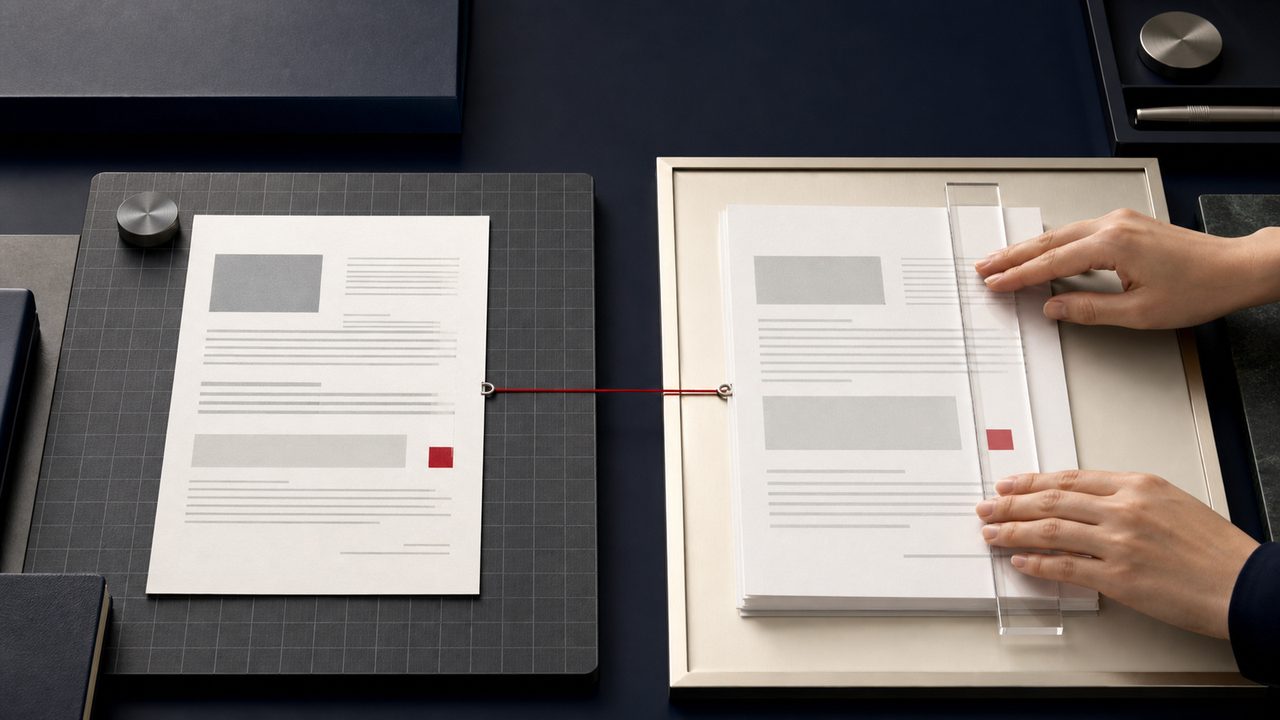
Certified translation from German into English gives you an English page that reproduces every field, stamp and register number on the original, signed off with a certificate of accuracy naming the translator. Documents from Germany, Austria, Switzerland and Liechtenstein all sit in this pair, and the rate is 24.95 for each page of up to 250 words with a 2 to 3 business day turnaround.
The German language documents that get certified most
Civil status records lead the list. The Geburtsurkunde and the fuller beglaubigte Abschrift aus dem Geburtenregister, the Heiratsurkunde or Eheurkunde, the Sterbeurkunde, the Meldebescheinigung showing registered residence, and the Stammbuch der Familie all appear regularly in immigration and citizenship files.
After those come the Führungszeugnis issued by the Bundesamt für Justiz for police clearance, divorce papers in the form of a Scheidungsbeschluss from a Familiengericht together with its Rechtskraftvermerk, and business records such as a Handelsregisterauszug with its HRB number and the Amtsgericht that holds it. Academic and professional files bring the Abiturzeugnis, university certificates, the Approbationsurkunde for physicians and the Arbeitszeugnis. German sits alongside seven other languages on our languages page, and every pair between them is available.
Urkunde and Zeugnis are two different documents
This catches people out constantly. In the German system the Urkunde is the instrument that awards the qualification and carries the title, while the Zeugnis is the record that lists the subjects, the marks and the final grade. A Bachelorurkunde and a Bachelorzeugnis are issued together and say different things.
Universities, licensing boards and credential evaluators normally want both. Sending only the Urkunde means the reviewer can see that a degree exists but cannot see a single grade, and the request for more evidence follows. The same pairing shows up at school level, where the Abiturzeugnis carries the subject results and the overall average that a US admissions office is looking for. Check the receiving institution's own list before you decide what to upload.
Umlauts, ß, and why your passport spells your name differently
German civil records write Müller, Schäfer and Strauß with the letters as they are. The printed data strip at the bottom of a German passport page cannot carry those letters, so the spelling is converted there, and Müller becomes MUELLER while Strauß becomes STRAUSS. The rule is that ä turns into ae, ö into oe, ü into ue and ß into ss.
The result is one person with two correct spellings, one on the birth certificate and one in the passport. A certified translation follows the document in front of it and does not harmonize the two, because changing a name to match a different record would make the translation inaccurate. If an agency queries the difference, the explanation belongs in your covering material. Where a document itself uses both forms, both are reproduced where they appear.
German grades run one way and Swiss grades run the other
German school and university marks run from 1 to 6 with 1 as the best mark, described as sehr gut, gut, befriedigend, ausreichend, mangelhaft and ungenügend. Austria uses the same direction on a 1 to 5 scale. Switzerland inverts it, marking from 6 down to 1 with 6 as the best and 4 as the pass.
So a 1 is the top result on a German Zeugnis and a failing result on a Swiss one, and a reviewer who assumes one convention while reading the other draws the wrong conclusion. A certified translation reproduces the marks exactly and translates any grade legend the certificate prints, which is often the most useful line on the page. It does not convert a German average into a US grade point average, since that is credential evaluation and a separate service.
Registry words with no clean English equivalent
A Geburtsurkunde is issued by a Standesamt and identified by an entry such as Geburtenregister Nr. 123/1985, where the second half is the year. The office, the register and the entry number together are how the German authority finds the record again, so they are kept intact rather than reduced to a generic label.
Swiss documents add the Heimatort, the place of origin. It is the commune where a family holds citizenship, it can be somewhere the person has never lived, and it is neither a birthplace nor an address. Austrian files bring the Staatsbürgerschaftsnachweis as proof of citizenship. Terms such as Rechtskraft, Beurkundung, Amtsgericht and Bundesland are handled by translating what they do while keeping the German term visible where the reader needs to match the English page against the original.
Old handwriting on pre war records
Citizenship by descent files often reach back to records written before 1941 in Kurrentschrift or Sütterlin, with printed matter set in Fraktur. Those hands are unlike modern German handwriting and a casual reader cannot decipher them at all.
They can be translated when the scan is good. What matters is resolution, so photograph or scan the page flat, in full, at high quality, and send the whole sheet rather than a cropped detail. Where a word genuinely cannot be made out, the translation marks it as illegible instead of guessing, which is the treatment a reviewer expects.
The Arbeitszeugnis and its coded language
German employment references follow a convention where the wording carries a rating. A phrase such as stets zu unserer vollsten Zufriedenheit sits at the top of the scale, while the same sentence without stets and without vollsten is a far weaker verdict.
A certified translation renders those sentences faithfully so an English reader sees precisely what was written. It does not restate them as an American style reference or add an interpretation, because a certificate of accuracy attests to what the document says. If the convention needs explaining to a US employer, that explanation belongs in a note from you.
Dates, numbers, price and turnaround
German dates are written day first with periods, so 07.09.1988 is 7 September 1988. Numbers reverse the American separators, so 1.234,56 is one thousand two hundred thirty four point five six.
One page is up to 250 words of source text, measured from your file so the total is on screen before you pay. Certified is 24.95 a page in 2 to 3 business days, Premium is 39.95 a page in 1 to 2 when a deadline is close, and Standard at 19.95 is a professional translation without the certificate in 3 to 5 business days. The tiers are compared on our services page, online orders run to 50 pages, and for larger files you can contact us for a quote.
If a translation is rejected because of a translation error we made, we correct it at no charge, and if the corrected translation is rejected again for that same error we refund what was paid for it, provided you notify us within 30 days with the written rejection. Our refund policy has the exact wording, and any recipient can confirm a certificate is genuine on our verification page.
Ordering a German to English certified translation
Upload the document as a PDF, choose German to English, pick a service level and pay by card. The steps are on how it works, common questions are answered on our FAQ page, and if you are new to the whole idea start with what is a certified translation.
Scan your Geburtsurkunde, Zeugnis or Führungszeugnis as a clear PDF and start an order. The measured price appears before you pay, and a qualified professional translator handles it from there.
Common questions
- Do I need the Geburtsurkunde or the register extract?
- The Geburtsurkunde is the short certificate and the beglaubigte Abschrift aus dem Geburtenregister is the fuller register copy with more detail, including later annotations. Agencies that want parents' details and subsequent entries usually prefer the register copy. Follow the written instructions from the office receiving your file.
- Will you translate Müller as Mueller to match my passport?
- No. The translation reproduces the spelling on the German document, so a Geburtsurkunde showing Müller is translated as Müller. The passport form with ue exists because the printed data strip on the passport page cannot show umlauts. If the agency asks about the difference, explain it in your covering material.
- Can you read old German handwriting from before the war?
- Kurrentschrift and Sütterlin records can be translated when the scan is legible. Send the whole page at high resolution rather than a cropped detail. Anything that truly cannot be deciphered is marked as illegible in the translation rather than guessed.
- Do you convert German grades into an American GPA?
- No. A certified translation prints the marks as they appear and translates the grading legend where the certificate includes one. Converting a 1 to 6 scale into a US grade point average is credential evaluation, a separate service, and the evaluator normally wants the certified translation first.
- Are Austrian and Swiss documents covered by this pair?
- Yes. German language documents from Austria, Switzerland and Liechtenstein are handled in the same pair at the same rates. The translator notes local particulars such as the Swiss Heimatort field for place of origin and the Austrian Staatsbürgerschaftsnachweis so a US reader understands what each field records.
Get your document translated
Upload a PDF, see the price measured from your real document, and receive a certified translation signed by a qualified professional translator. Every price is shown before you pay.
Read next
- Italian to English Certified Translation
Certified Italian to English translation of comune records, casellario certificates and Italian degrees by qualified professional translators. 24.95 per page.
- USCIS Certified Translation Requirements, Explained in Plain English
USCIS requires a full English translation and a signed certificate of accuracy for every foreign language document. Here is exactly what that means.
- Do You Need a Notarized Translation for USCIS?
USCIS does not require notarized translations. Learn what the rule actually asks for, and when a notarized or apostilled translation is still needed.